AI 研究
AlphaFold Database Adds 8,028 Predicted Viral Protein Complexes as Inference Pipeline Goes Open Source
The collaboration released high-confidence complex predictions for 2,812 viral proteomes, along with a GPU computing pipeline. Deployment still requires large GPUs and cluster infrastructure, and predicted structures need experimental validation.
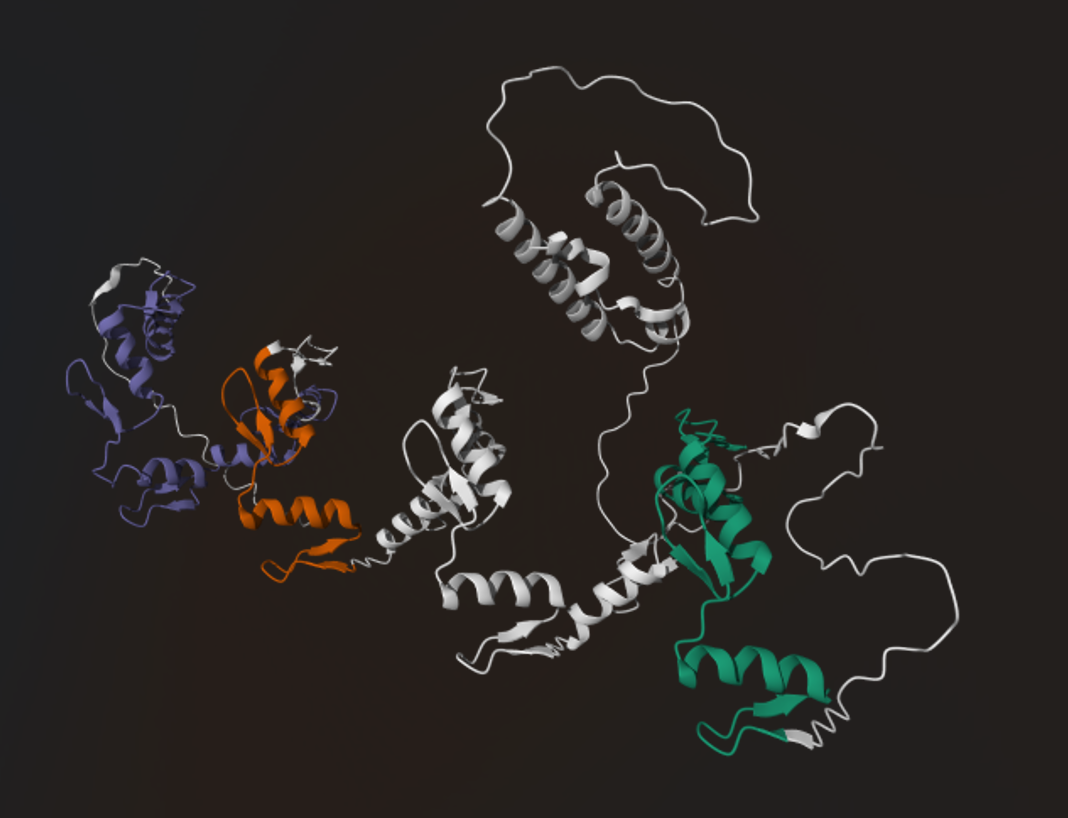
Teams from EMBL-EBI, Google DeepMind, NVIDIA, and other organizations published a new batch of viral protein complex predictions on September 24. The collaboration covers 2,812 viral proteomes across 23 virus families and produced 5,279 high-confidence heterodimers and 2,749 homodimers. The former are made up of different proteins; the latter, of identical proteins. AlphaFold’s pandemic preparedness portal also integrates other data, so these 8,028 entries are not everything it contains. [Official announcement](https://www.ebi.ac.uk/about/news/technology-and-innovation/alphafold-database-adds-viral-protein-complexes-to-support-pandemic-preparedness/), [database update](https://alphafold.ebi.ac.uk/)
The technical work centers on combining sequence search, structure inference, and quality filtering into a large-scale pipeline. The newly released BioNeMo Structure Prediction Pipeline uses GPU-accelerated MMseqs2 searches to build multiple sequence alignments. For folding, it can use OpenFold2 with AlphaFold2-Multimer weights and the BioNeMo Inference Runtime. Post-processing evaluates protein interaction interfaces, checks for spatial clashes, and exports structure files and data manifests. [Repository documentation](https://github.com/NVIDIA-BioNeMo/BioNeMo-Structure-Prediction-Pipeline)
Research teams can use the candidate structures directly or apply the pipeline to their own targets. Each stage runs as a containerized job scheduled through Slurm, passing data through local or S3-compatible storage and retaining input checksums and execution logs. This design could reduce duplicated setup and computation, giving follow-up experiments a prioritized list of candidates. Publishing the data and pipeline together also provides a basis for examining how the predictions were produced. [NVIDIA announcement](https://blogs.nvidia.com/blog/open-protein-dataset/), [pipeline architecture](https://github.com/NVIDIA-BioNeMo/BioNeMo-Structure-Prediction-Pipeline)
Deployment requirements remain demanding: the documentation calls for at least 80 GB of GPU memory and cluster container infrastructure, and users must supply sequence databases, model weights, and reference data. The public release requires data to be handed off stage by stage; there is not yet a single command that runs the entire pipeline. Configuration must also explicitly select the `public` preset, or it will select `internal`. [Hardware requirements](https://github.com/NVIDIA-BioNeMo/BioNeMo-Structure-Prediction-Pipeline), [release limitations](https://github.com/NVIDIA-BioNeMo/BioNeMo-Structure-Prediction-Pipeline/blob/main/docs/status.md)
A high confidence score is still a model judgment, and possible binding conformations need experimental confirmation. EMBL-EBI states that structures alone cannot determine the effects of viral mutations or how a virus will behave in practice. Anyone using the results to train or evaluate other models should retain provenance and confidence labels, and compare them with experimental structures to assess errors, rather than treating candidates as validated labels. Areas to watch include experimental validation across virus families, resource requirements for different input lengths, and end-to-end pipeline throughput. Successful execution alone does not demonstrate scientific accuracy or performance across hardware. [Research limitations](https://www.ebi.ac.uk/about/news/technology-and-innovation/alphafold-database-adds-viral-protein-complexes-to-support-pandemic-preparedness/), [validation limits](https://github.com/NVIDIA-BioNeMo/BioNeMo-Structure-Prediction-Pipeline/blob/main/docs/status.md)